
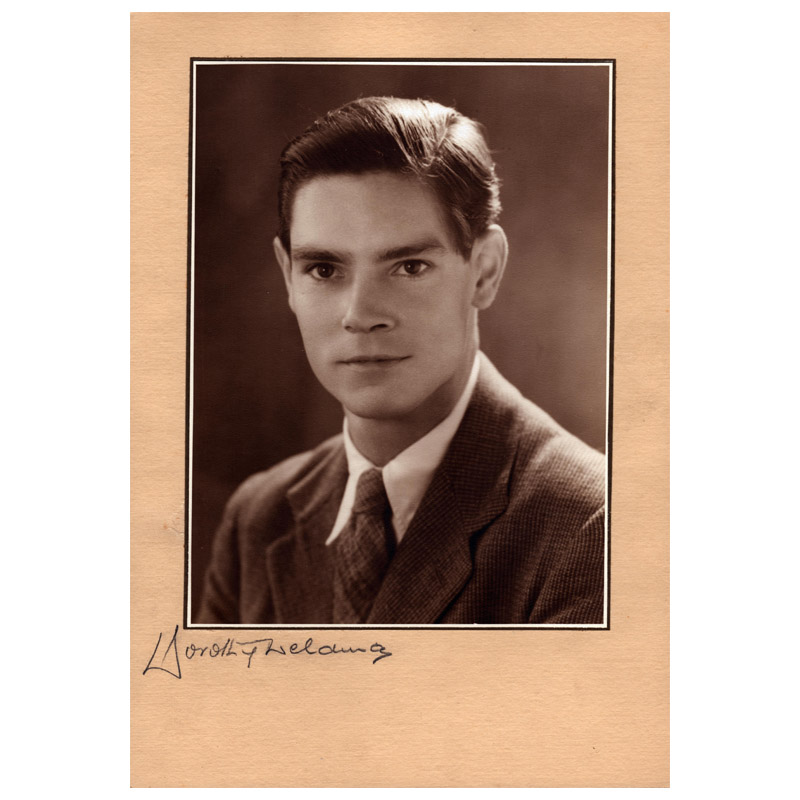
Portrait by Dorothy Welding
Dorothy Welding
(1894-1954)
An Australian professional photographer known for her high society portraits taken in Sydney between 1931 and 1954.
Born in Melbourne on 9th November 1894, her birth name was Eveline Jacqueline O’Brien, though she later preferred to be known as Gladys Jacqueline O’Brien or Gladys Jessie O’Brien. She was known professionally as Dorothy Welding, controversially establishing a photography studio in Sydney under this name on 25th November, 1931. This was controversial because of the similarity to the name of the renowned English royal and high society photographer Dorothy Wilding.
Wilding’s work will have been known in Australia when Welding’s studio was in operation, with her images of the Royal family being published across the Commonwealth in publications and on postage stamps, so it is reasonable to assume that Welding was fully aware of the other artist when establishing her studio. The decision to name her studio so similarly is highly likely to have been a conscious decision to associate herself with Wilding and bolster its reputation by drawing on Dorothy Wilding’s critical acclaim, seeking to attract a similar level of high class clients. Images of both Wilding and Welding’s photography studio logos show a striking similarity, again creating a (completely unauthorised) sense of shared identity between the two. Whilst Wilding never formally challenged Welding’s attempts to pass off her reputation, Perth photographer Susan Watkins, who was both a student of and later employee of Wilding in England, recounted in an interview how much the knowledge of Welding’s studio upset and appalled her.
Welding was proprietor of the studio located on the 7th floor of Boomerang House, 139 King Street, Sydney until her death in 1954. Boomerang House was an epicentre for photography in Sydney, famous for housing a host of notable photographers and studios, including May Moore, which again would have helped give legitimacy to Welding’s business.
Family connections may also have played a part in her studio’s success, as Welding’s sister Rene was married to an accountant for the consul for Ecuador in Sydney. The couple moved in high circles, which may have helped give Welding access to the Australian elite and her core clientele.
Welding’s portraits included notable sitter Florence Taylor OBE who was the first woman to qualify and practice as an architect in Architect in Australia. Her portraits were softly focused, giving a
romanticised feel and were widely published in high profile Australian magazines and newspapers of the time, including The Home, The Bulletin, The Sydney Morning Herald and The Sun. In the 1930’s The Home: An Australian Quarterly featured her work within a section titled ‘Studies by Dorothy Welding”.
Sources suggest at least 880 portraits from the Dorothy Welding Studio were published in the Australian media.
The studio was subject to a number of legal disputes with clients over payment, instigated by Welding, some of which were successfully ruled in her favour.
She was later known by her married name Gladys Jacqueline Merchant after marrying Douglas Gordon Merchant in 1943.
Her parents were of Irish descent and she had 6 older siblings. She was born 3 months after her father passed away suddenly from a stroke. Exactly how Welding came to start her photography career is unknown. She may have begun her photography career as a studio assistant in Melbourne, where she lived with her mother (who died in 1922). She had relocated to Sydney by 1930 and subsequently found an opportunity to set up her studio.
She fell to her death from a window at her home in 1954, after which the studio was put up for sale. Her death was recorded as undeterminable as an accident or suicide, but it was ruled that no third party was involved. She was partially paralysed at the time of her death from a stroke the year before and slept close to the window she fell from.
Biography written with thanks to photoria.com.au
By Louisa Osmond
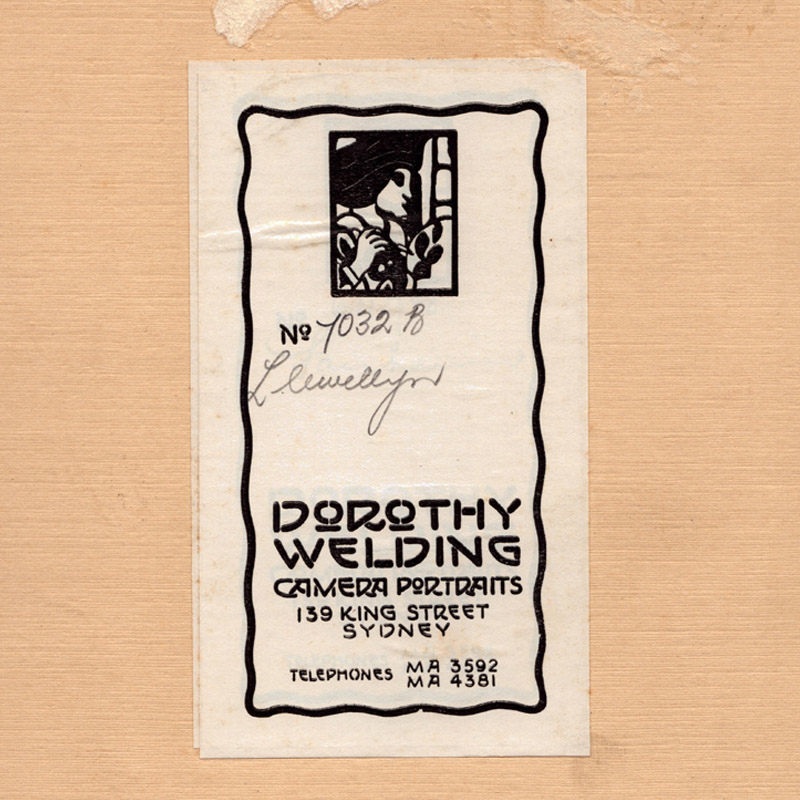
Verso – Dorothy Welding
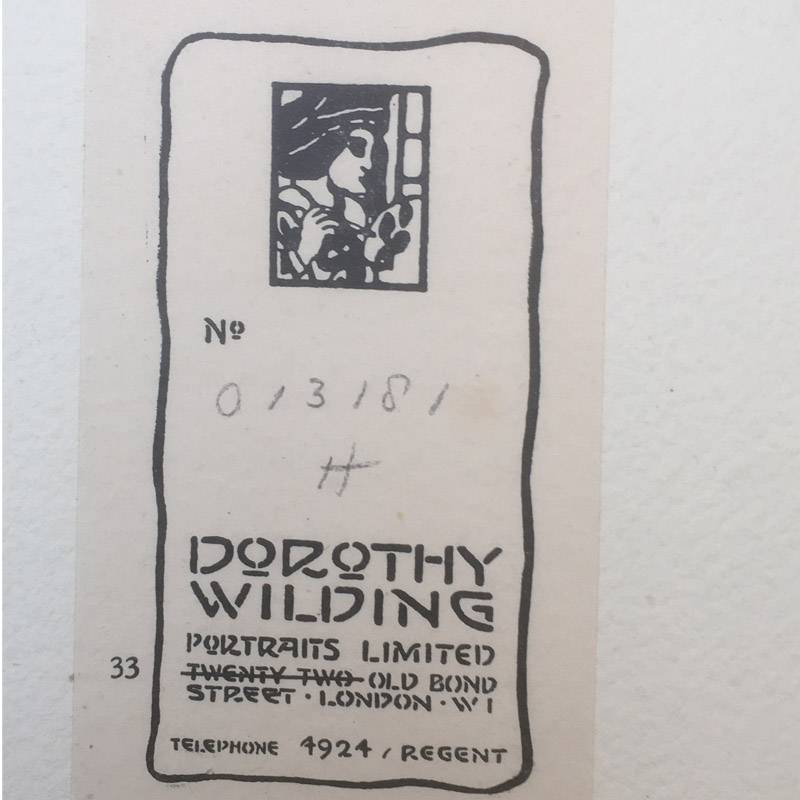
Verso – Dorothy Wilding