Profile by Celine Laguarde
Celine Laguarde (1873 – 1961)
Pictorialist Pioneer
Celine Laguarde was born in Biarritz , France on the 2nd of November 1873. She spent most of her early life moving between Paris, Aix and Marseille where she began developing her career in the academic arts which later earnt her the title of Ordre des Palmes académiques in 1907, a prestigious title, given to those who have notably contributed in the French academics.
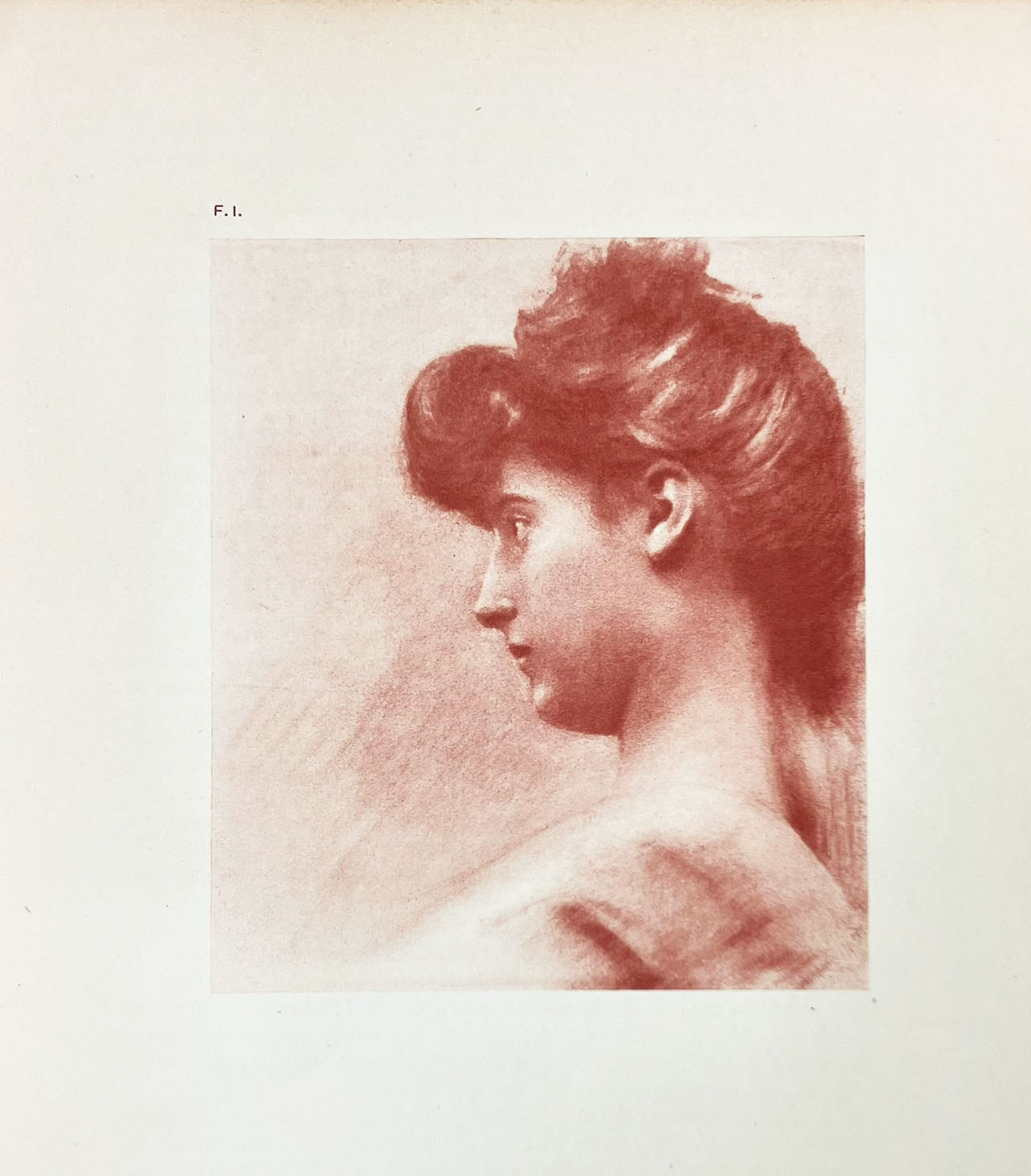
During the early 1900s, whilst a student of French photographer Robert Demachy, she learnt to master the Gomme Bichromate, oil-based and oil transfer techniques of photograph printing, which involved using alternates to the traditional chemicals used in printing. This helped create her distinct manipulated photos, with a rich texture almost reflecting that of a graphite drawing and a much more vibrant use of colours. ‘Profile’ from 1904 being a strong example of this, with a brilliant red hue complementing the aforementioned stunning texture, shifting a simple profile into an aesthetic that could only be described as fine art.
Celine was a pioneer of the Pictorialist movement, an artistic movement in the early 20th century that challenged the rhetoric that photos should only be used for documentation and that they should reflect reality. She was notably the only woman considered to be a pioneer of the movement. This was reflected in her inclusion in prestigious journals and showcases such as the L’Épreuve Photographique journal in 1904-5 and at the Photo Club de-Paris display in 1901, where she was the only woman included.
After marrying Swiss doctor, Edouard Fredric Bugnion, and following the collapse of the Pictorialist movement because of WWI, Laguarde started moving towards microphotography to support her husband’s entomology studies. Despite this, her works continued to be displayed throughout France and internationally through photography magazines and showcases, with her last documented showcase being in Los Angeles, 1930.
With the outbreak of WWII, the annexation of France and the death of her husband, Celine shifted her life to Switzerland where she continued to contribute to the arts with the financing of a new organ in the Abbey of Saint-Maurice d’Aguane, Lausanne. She was later buried there following her death on the 20th of May, 1961.
Her works faded to obscurity following her death until the early 2010s, where the Musee d’Orsay recovered large collections of her work. They used these works in two exhibitions :Qui a peur des femmes photographes? And Céline Laguarde (1873-1961) Photographe
Which brought her contribution to the pictorialist movement and French photography scene before the First World War back into the public view. They stated that: “This exhibition is an invitation to rediscover Laguarde on two levels: as a female photographer who earned a level of recognition that no woman in France had achieved since the invention of the medium, but also – and most importantly – as an artist who in her lifetime was already considered to be one of the most important photographers of her era.”
By Levi Stoney
In the Collection
- Tear sheet from unknown magazine featuring image (above) by Celine