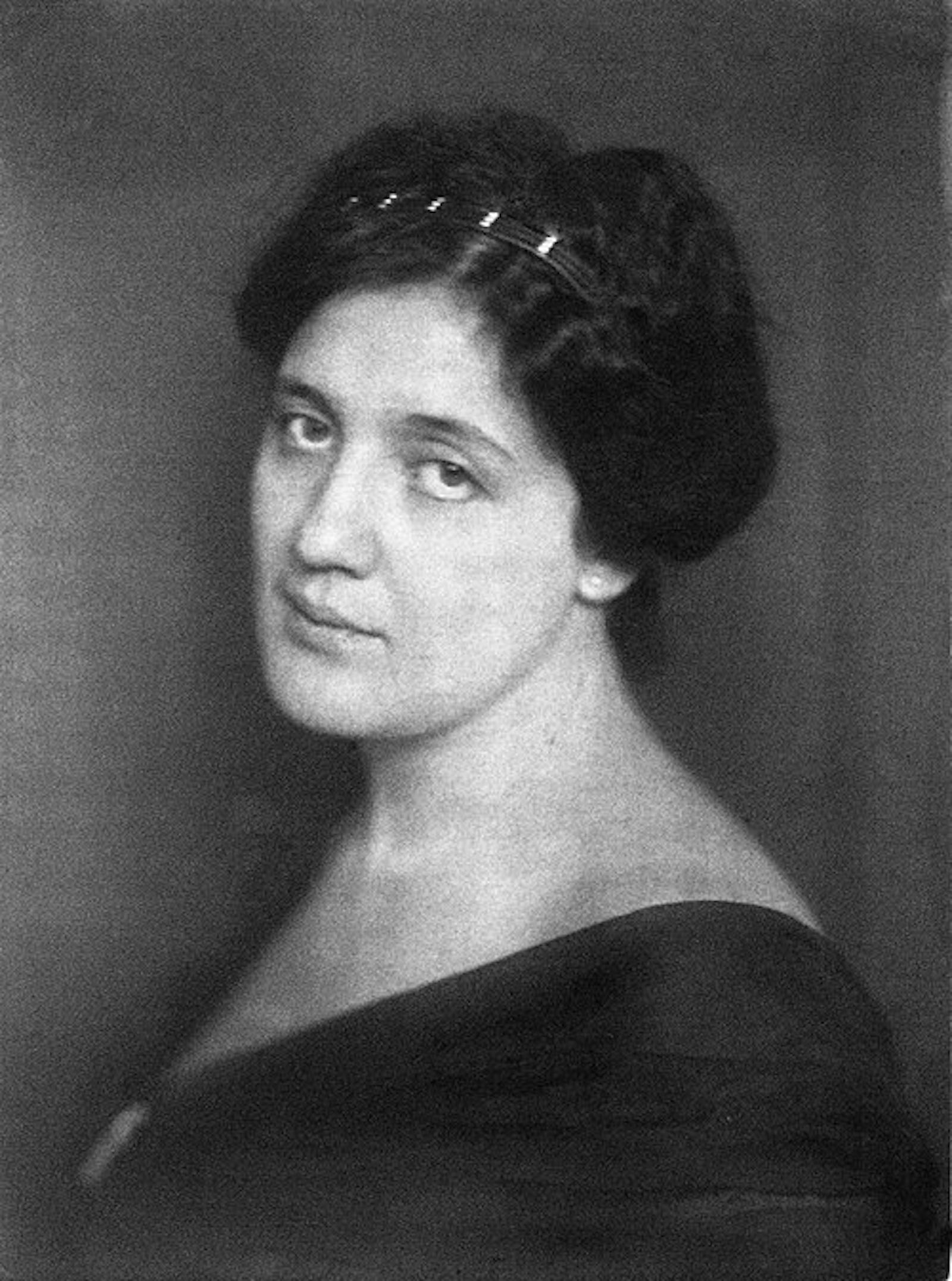
Austrian psychoanalyst Melanie Klein c 1909 Budapest, aged about 30, by Mate Olga Wellcome
Olga Máté (1878 - 1961)
One of Hungary’s first female professional photographers
One of Hungary’s first female professional photographers, Olga Mautner (Máté) studied photography in Germany and Hungary and opened a portrait studio in 1899 at No. 21 Fő utca, Budapest. She was published with other contemporary female photographers like social documentarian Kata Kalman (1909-1948) and appeared in journals like the shortlived A Fény (The Light).
In 1912, she moved her studio to No. 12 Veres Pálné utca and became known for her use of the bromoil process to create painterly portraits. Her award winning work was well regarded for her expert use of lighting and sensitive posing in portraits of women and children, as well as the intelligentsia of her time. Her home, with philosopher Béla Zalai, a widower with two children, was a meeting place for intellectuals and she photographed many of them including her friend writer Margit Kaffka (1880-1918) and poet Babits Mihály.
Olga was also a supporter and organizer for the Hungarian suffrage movement and photographed its leader Rosika Schwimmer at the international conference in Budapest in 1913 along with the head of the International Woman Suffrage Alliance, American Carrie Chapman Catt (1918).
Besides her beautiful portraiture, she also experimented with still life, dance, nudes and landscape. I like her dramatic 1937 landscape ‘Foals are getting ready for watering’ for its powerful composition, as well as her modernist still lives and flowers from the 1920s.
Olga was sadly widowed in 1915 leaving her in a precarious familial and financial position.
As a committed political reformer, she helped hide anti-communist friends during purges after the war and assisted in many of their escapes, and her career suffered in the oppressive political climate.
She trained her apprentices Ferenc Haár and Mariann Reismann (1911-1991) the latter of whom took over her studio in 1938, specialising in dance and child portraits, and Olga’s work fell into obscurity.
Her archive can be found in the Hungarian Photographic Museum